
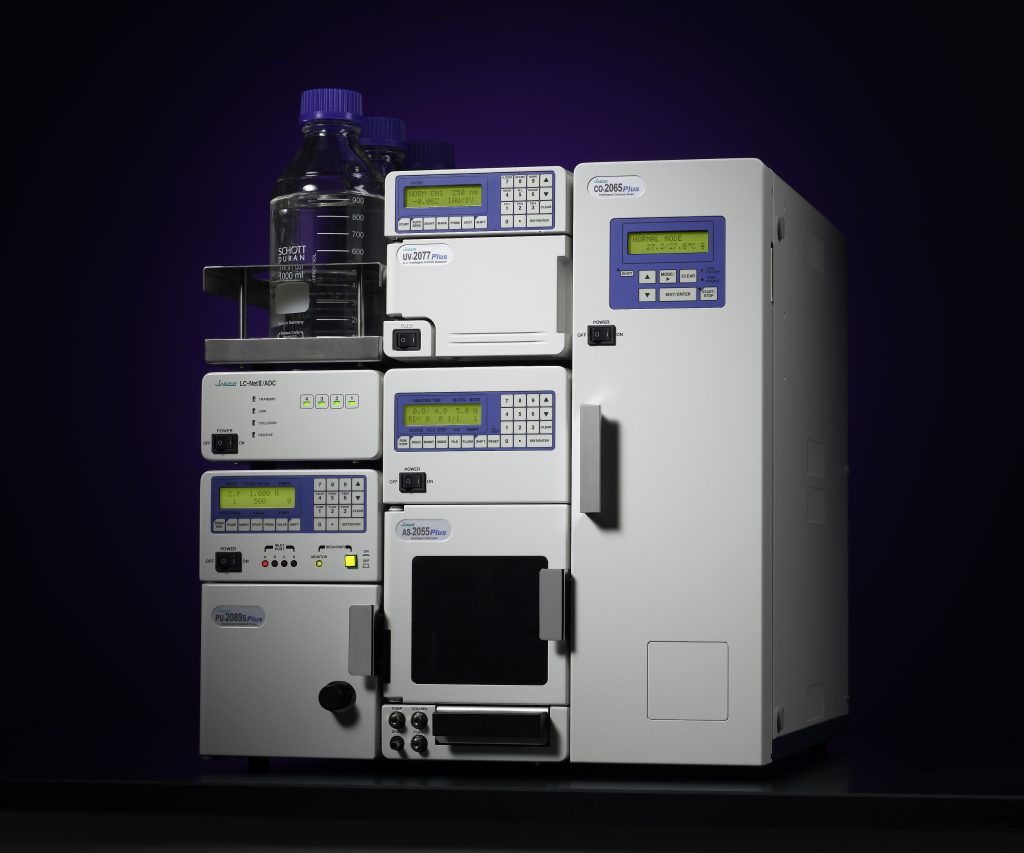

One of the fundamental methods in analytical chemistry is High-Performance Liquid Chromatography
(HPLC). The technique is used to separate analytes from a mixture of chemicals. This separation utilizes a
mobile phase that is forced by pressure to pass through a column packed with a stationary phase. Only
liquid samples can be analyzed using the HPLC system. HPLC enables both qualitative and quantitative
analysis by separating chemicals that are dissolved in a liquid sample.
Quality control (QC), quality assurance (QA), pharmaceutical drug development, food, and
environmental testing laboratories frequently employ routine HPLC for analysis. Specialized LC
techniques are used to identify compounds based on the requirements of the analysis. For example,
preparative HPLC and Ultra High-Performance Liquid Chromatography (UHPLC) are employed. The
choice of technique depends on the sample type and the type of analysis.
Working principle of High-Performance Liquid Chromatography
The mobile phase is the solvent that is utilized in a liquid sample for HPLC analysis to separate the
various components. A liquid sample is carried by the mobile phase through the column and onto the
detector, whereupon different degrees of interaction between the compounds or analytes and the
stationary phase cause them to separate. A detector such as DAD, FLD, ELSD and MS measures the
analyte content, which is eluting from the column. Finaly, collected data from the detector analyzed by
data analysis software. An HPLC analysis's translated data output is known as a chromatogram, in which
the y-axis measures a particular signal produced by the detector and the x-axis represents time.
Reversed-phase High-Performance Liquid Chromatography
The technology of Reversed-Phase High-Performance Liquid Chromatography (RP-HPLC) is extensively
employed for the separation of various substances. In reversed-phase HPLC, the mobile phase is polar,
while the stationary phase is nonpolar. Common mobile phases are water, acetonitrile, methanol, and
buffer solutions. Compounds are separated in reversed-phase HPLC based on their interactions with the
nonpolar stationary phase. Polar compounds elute earlier due to their higher solubility in the polar
mobile phase and lower affinity for the nonpolar stationary phase. Optimizing the separation of
compounds according to their hydrophobic characteristics involves adjusting the composition of the
mobile phase as well as other parameters.
Normal-phase High-Performance Liquid Chromatography
The chromatographic method known as normal-phase high-performance liquid chromatography (NP-
HPLC) uses a nonpolar mobile phase and a polar stationary phase. The stationary phase in normal-phase HPLC is typically a polar material such as silica gel or alumina. These materials are often used in their
untreated or treated forms to provide a polar surface. It has high polarity compared to the mobile
phase. The mobile phase is nonpolar or less polar compared to the stationary phase. Common mobile
phases include hexane, heptane, or mixtures of these with more polar solvents such as ethyl acetate or dichloromethane. Relatively low polar compared to the stationary phase. The polar stationary phase
and the nonpolar mobile phase interact differently, which is the basis for separation in normal-phase
HPLC. Less polar molecules elute earlier and interact less with the stationary phase, whereas more polar
compounds interact more and elute later.
Types of detectors are used in HPLC system
- UV Detectors: photodiode array or diode array detector (DAD), and Variable Wavelength
Detector (VWD) - Fluorescence Detector (FLD)
- Refractive Index Detector (RID)
- Evaporative Light Scattering Detector (ELSD)
- Conductivity Detector
- Electrochemical Detectors
- Radioactivity Detectors
- Chemiluminescent Nitrogen Detector
- Chiral Detectors
- Charged-Aerosol Detection
Key phrases in High-Performance Liquid Chromatography
- Stationary Phase: The phase in the column that remains fixed in place and interacts with the analytes.
- Mobile Phase: The solvent or mixture of solvents that moves through the column, carrying the analytes.
- Retention Time: The time it takes for a compound to pass through the column and be detected.
- Resolution: The ability of the HPLC system to distinguish between two closely eluting compounds.
- Gradient Elution: A technique where the composition of the mobile phase changes during the time.
- Isocratic Elution: A technique where the composition of the mobile phase remains constant throughout the separation.
- Analyte: The substance or component being analyzed.
- Flow Rate: The rate at which the mobile phase is pumped through the column, typically expressed in milliliters per minute (mL/min).
- Baseline: The background signal in a chromatogram, representing the detector response in the absence of analytes.
- Calibration Curve: A graph used to determine the concentration of an analyte by comparing the detector response to known standards.
- Chromatogram: A graphical representation of the detector’s response over time, showing the separated components.
References
- Introduction to Modern Liquid Chromatography – Lloyd R. Snyder, Joseph J. Kirkland, John W. Dolan
- The LC Handbook – Agilent Technologies
- The HPLC Expert: Possibilities and Limitations of Modern High Performance Liquid Chromatography – Stavros Kromidas
- Liquid Chromatography – Salvatore Fanali, Bezhan Chankvetadze, Paul R. Haddad, Colin Poole, Marja-Liisa Riekkola
Read more…